
The Milburn Review is right to ask what happens next. Young people already know.
Posted on:
The Milburn Review is right to ask what happens next. Young people already know.
The first sign that a young person is losing confidence may not appear in a national statistic. It may look like staying in a bedroom, missing a routine, losing contact with friends or deciding that opportunities are for other people. By the time a young person is counted as not in education, employment or training, the disconnection may have been building for a long time.
That is why the interim Young People and Work Review led by Alan Milburn matters. It puts a national spotlight on a problem that young people, families, schools and community organisations have been describing for years. But the next stage must do more than diagnose. It must listen to the people living this reality and invest in routes that young people will actually use.
At Genuine Futures, we are not claiming to have every answer. No single organisation can solve this alone. We do know that relationships, early opportunity and practical experience can engage young people who may not respond to a conventional offer. We have been building and testing that approach in Bolton and beyond. Now lived experience needs a seat at the table where national solutions are shaped.
A long-standing challenge needs an earlier response
The Milburn interim report says that 84% of the young people in its survey who were not in education, employment or training wanted a job, education or training. Its conclusion is clear: the challenge is not a lack of aspiration. The report also notes that the headline NEET rate has remained within a narrow range for much of the past three decades, while the routes into work and the conditions facing young people have changed.
That history matters. This is not an overnight problem, and it did not begin with one generation. The causes and labour market have evolved, but the pattern has persisted. For more than two decades, governments have often concentrated on what the report calls supply-side responses: improving young people’s skills and employability. Those steps matter, but they cannot substitute for accessible entry routes, supportive relationships, good work experience and employers prepared to give someone a first chance.
The report also raises a specific point about entrepreneurship. It describes a decline in self-employment among people aged 25 and under since 2020, and says platform and gig work has not replaced that route or reliably offered progression and training. That is a finding about the changing landscape—not a recommendation that every young person should become an entrepreneur. Our view is that enterprise should be one genuine option in a wider set of pathways, alongside education, apprenticeships, employment and community participation.
The review’s diagnosis should prompt action now: help young people build confidence and experience before they become isolated from opportunity. Prevention is not simply a slogan. It means noticing early signals, responding proportionately and staying alongside a young person long enough for trust and progress to take root.
Blake’s story: a first step that mattered
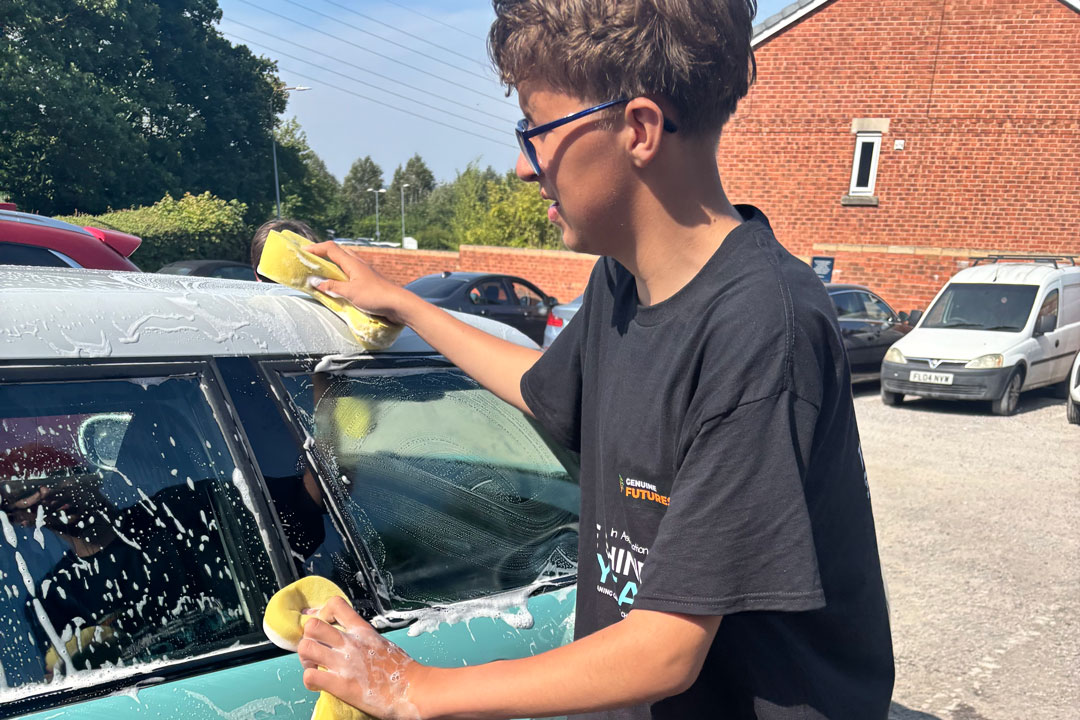
Blake is 13. When we first met him, his confidence was very low and much of his time was spent in his bedroom. Over the school holidays, he began coming to Genuine Futures’ We Shine Any Car community events at the White Horse pub on Stitch Mill Lane in Harwood. He found a reason to get out, meet people and take part.
The activity gave Blake more than something to do. Around the team and real customers, he could practise speaking to people, serving customers, sharing tasks and contributing to a team. Those everyday moments create chances to build communication, reliability and confidence in a real setting. They also allow adults to notice strengths that can be hard to see when a young person is disengaged or withdrawn.
“It helped me get out of my bedroom.”
That is Blake’s own description of what changed for him. His published story on the Genuine Futures website also describes him taking part in boxing and circuit training with Iron Minds and helping deliver Clean Futures leaflets. The important point is not that one activity fixes everything. It is that a young person was met with an invitation, a team and an opportunity to take a manageable first step.
Blake wants to share his experience with other young people. He has asked to visit his school regularly, including on a fortnightly basis, and to speak about what has helped him. That matters because he is not being presented as a finished success story or as a lesson for others. He is a young person still building his confidence, who wants his voice to help someone else feel less alone. Any school presentation or further sharing of his story should continue to be shaped around Blake’s wishes and the appropriate family and safeguarding arrangements.
For a 13-year-old, prevention means acting while there is still time to strengthen connection, confidence and belonging. It means creating opportunities before a young person has to reach crisis before anyone takes notice.
Sam Smith: lived experience can inform prevention
I know what it can mean when adults see that a young person is struggling but the right support does not arrive in time. I was excluded from school at 13, entered care and later experienced youth justice, prison and homelessness. My life could easily have been reduced to those labels. Becoming a father became a turning point. With support from The Prince’s Trust, I went on to build a cleaning business that employed 22 people and operated a five-lane car wash. I later worked as a Morrisons Community Champion before returning to Bolton and helping establish Genuine Futures.
I share this story because early intervention cannot be an abstract policy idea. At 13, I needed someone to see more than the behaviour or the file. I needed an adult to recognise that a future was still possible. My journey was not simple, and it should not be used to suggest that every young person can overcome barriers through determination alone. People need relationships, practical help and real openings. The systems around them have a responsibility to make those openings possible.
Genuine Futures grew from that belief: that lived experience has value when it is connected to action, partnership and opportunity. I want young people and families involved in designing the support, not only invited to tell their story once decisions have already been made.
Mike Alleyne: listen first, then build the opportunity
Genuine Futures Co-Director Mike Alleyne brings his own lived experience of growing up amid poverty and gang culture in Manchester, alongside years of work in business, coaching, mentoring and personal development. His perspective reinforces an essential point: a young person is not a problem to be managed. They are a person with their own strengths, ideas and goals.
Mike’s approach begins with listening and building a trusted relationship. Young people should help shape the opportunities offered to them, and adults need to act on what they hear. That is especially important for young people who have experienced disappointment or rejection and may reasonably be cautious about another programme or promise.
“There’s no one-size-fits-all pathway. Every young person has different ideas, skills and talents.”
The quote is from Mike’s published account of the Genuine Futures approach. It reflects what we see in practice: progress can mean returning to education, trying work experience, developing an enterprise idea, finding a supportive routine or taking part in a community project. The next step should fit the young person, not force every young person into the same route.
Young people, parents and practitioners are telling us what works
Young people’s words should carry weight in this debate. In a Genuine Futures story about his progress, Luis said: “We can achieve anything now.” Cameron has described the importance of a first conversation and a place at the table. These are not decorative quotes for a report. They are reminders that young people can identify what changed: someone listened, someone made space, and there was a chance to contribute.
Parents see changes that a form or attendance record may miss. One mother wrote of her son: “For the first time, Luis feels like he truly belongs.” Another parent described seeing “such a positive change in him.” Belonging and confidence are not soft extras. They can help make the next step—towards learning, training, work or a healthier routine—feel possible.
Practitioners see the effect of putting young people into a real task with a real purpose. After a We Shine Any Car Skills Academy session with Woodlands Aurora School, Stuart Jamieson described the engagement as “brilliant”. The young people had standards to meet, tasks to complete and teammates relying on them. That kind of applied experience can make communication, teamwork and responsibility tangible.
Our responsibility is to listen without turning individual stories into proof of a universal outcome. These voices show what is possible and what matters to the people involved. Stronger evaluation must now help us understand for whom the approach works, in which settings, and what support is required to sustain progress.
A 360-degree approach: connection, experience and progression
We describe our approach as 360-degree because young people’s lives do not divide neatly into separate service categories. Confidence, wellbeing, family circumstances, education, skills, relationships and employment can all affect one another. A useful response has to connect those parts around the young person.
In practice, that can mean a low-pressure first conversation; a consistent adult who follows through; activities that build routine and wellbeing; a practical project where young people contribute; chances to develop enterprise and work skills; and links to schools, colleges, employers, families and other services when they are needed. It also means checking what happens after the initial intervention. A referral is not the same as a relationship, and a short placement is not a pathway unless there is a next step.
We Shine Any Car is one example. In a community setting, young people can practise welcoming and serving customers, working safely as a team, completing a task to an agreed standard and reflecting on what they have learned. Clean Futures creates another route through community and environmental enterprise. Boss Your Future and other activities can connect young people with enterprise, coaching, skills and progression. These are vehicles for learning and connection—not a claim that every participant should work in one industry.
Genuine Futures has spent the past three years developing and testing practical education and enterprise programmes. That gives us a foundation to build on, not a reason to overstate what we know. If the model is to grow nationally, it should be adapted with local young people and partners, supported by trained and trusted adults, and evaluated for participation, wellbeing, skills, progression and longer-term outcomes. Scale should spread the principles while allowing communities to shape the delivery.
No single organisation can solve this
Schools cannot carry this alone. Neither can councils, employers, health services, youth organisations, families or young people themselves. Each sees part of the picture and controls only some of the opportunities. Better outcomes require shared responsibility: early identification without stigma; clear routes between services; meaningful work experience; employers willing to open doors; and young people with a real voice in decisions.
That is why the next phase of the Milburn Review should include young people, parents, frontline practitioners and community organisations that have been building and testing solutions for years. Lived experience is not an optional perspective to add once the plan is written. It is evidence about how services feel at the point of contact—and whether people can access them at all.
We have spoken with ministers and local MPs because the choices made now will shape young people’s futures for years. We are disappointed that Genuine Futures and the young people we work alongside have not had a seat at the table so far. The answer is not to claim that we have a complete national blueprint. It is to ask for a serious partnership: bring the voices of young people into the room, test what works, share what we learn and fund the parts that make a difference.
The question is what we do next
The Milburn Review has put a long-standing challenge back into the national conversation. Its findings underline that aspiration exists, that entry into work has become harder for many young people and that youth self-employment has declined. Now the task is to turn diagnosis into a response that starts earlier and reaches the young people who are least likely to walk through a service’s door by themselves.
Blake’s story is still unfolding. Sam’s story is one example of what can happen when a young person eventually finds a route forward. Mike’s work reminds us that listening and trust are part of the infrastructure of opportunity. Together, these stories make a case for prevention in action: young people shaping the support, adults showing up consistently, and practical experiences that lead somewhere.
We do not have all the answers. No organisation does. But we know that young people engage when an opportunity feels real, when they are treated with respect and when someone sees potential in them before a crisis forces everyone else to look. We have been building those opportunities for years. It is time to connect that learning to a wider national effort—and to make sure young people are at the table as that future is designed.
Genuine Futures CIC works with young people, families, schools, employers and community partners to bridge the gap to opportunity. If you are a school, college, employer, commissioner or funder, we want to work with you to create practical, preventative routes that young people will trust and use.
Sources and publishing notes
The article copy is drafted for publication on Genuine Futures’ website. The YouTube video link can be added as an embed after the opening section or beside the call to action; the link was not yet supplied when this draft was prepared.
Because Blake is 13, confirm that any new publication, school presentation, photography or video use is within Blake’s wishes and the relevant parent or guardian consent and safeguarding arrangements. His existing published story is linked below; the school-facing use should remain led by him.
- Department for Work and Pensions, Young People and Work: Interim Report (2026)
- Genuine Futures, From Isolation to Opportunity: Blake’s story
- Genuine Futures, Why Listening to Young People Changes Lives: Mike Alleyne
- Genuine Futures, It Takes a Town: Building Opportunity for Bolton’s Young People
- Genuine Futures, You’re Changing Lives: A Mum’s Message
- Genuine Futures, No Experience. No Job. No Way In
- Genuine Futures, Parent testimonial for Boss Your Future
- Genuine Futures, Sam’s Story
Editorial note: The national figures and findings should be checked against the final Milburn report when it is published. The article refers to the interim review and clearly frames Genuine Futures’ wider model as an approach to test, adapt and evaluate.