
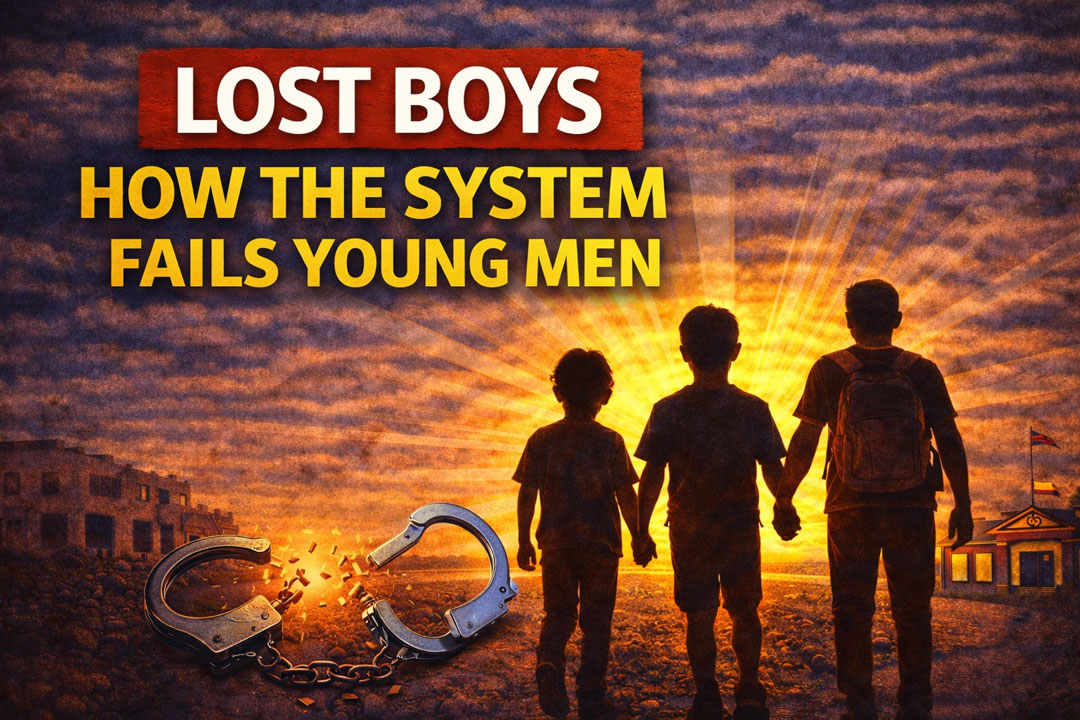
Lost Boys: How the System Is Failing Young Boys – and Why Government Must Listen
Posted on:
By Sam Smith, Founder, Genuine Futures
Across the UK, a quiet but devastating crisis is unfolding — one that disproportionately affects young boys, particularly those from disadvantaged, care-experienced, and marginalised backgrounds.
The Centre for Social Justice’s report Lost Boys describes a generation of boys falling behind at every stage of life — in education, wellbeing, employment, and the justice system. Many feel disconnected, unsupported, and increasingly invisible.
For too many, the pattern is clear:
It begins in school.
It escalates through care placements.
And too often, it ends in the youth justice system — or worse.
This is not a failure of individual boys.
It is a failure of systems that intervene too late, listen too little, and withdraw support too early.
I know this not just as a practitioner — but as someone who lived it.
When School Becomes the First Point of Exclusion
The Lost Boys report highlights that boys are significantly more likely to be:
- excluded from school,
- labelled as disruptive or challenging,
- behind in literacy and attainment,
- disengaged from education at an early age.
Instead of receiving early, trauma-informed support, behaviour is often punished.
When I was a young boy, my behaviour was never seen as communication. It was treated as defiance. No one asked what I was carrying or why I struggled to sit still, focus, or trust adults. The response was sanctions, exclusion, and low expectations.
That moment — when school stops feeling safe — is often the beginning of the end.
Once excluded, the pathway becomes predictable:
disconnection → missed education → vulnerability → risk.
Care Does Not Always Mean Stability
Across England, more than 81,000 children are currently looked after by local authorities. Across the UK, the number is over 107,000. Boys make up a significant proportion of this group.
Many enter care already carrying trauma — abuse, neglect, instability, and loss.
Instead of stability, too many experience:
- repeated placement moves,
- disrupted education,
- fractured relationships with trusted adults,
- care that ends abruptly at fixed ages.
At 14 years old, I was placed in a secure children’s home. I was there for seven days — but those seven days showed me how quickly a child can be labelled, contained, and moved on.
I wasn’t “bad”.
I was overwhelmed, frightened, and unheard.
Care was meant to protect me. Instead, it confirmed that I was already being written off.
From Care to Criminalisation
The Lost Boys report makes clear that boys who experience educational failure, care instability, and a lack of positive role models are far more likely to become involved in the criminal justice system.
When care and education fail, other systems step in — not to support, but to control.
Young boys who are:
- excluded from school,
- disconnected from family,
- living in unstable housing,
- lacking purpose and belonging
become highly visible to the youth justice system.
They are also actively targeted by county lines and criminal exploitation, where vulnerability is seen as opportunity.
After leaving care and becoming homeless, I spent years moving in and out of the criminal justice system. Not because I wanted that life — but because no safe, realistic alternatives were available.
As Lost Boys makes clear, criminalisation is often the final outcome of long-term neglect, not a sudden moral failure.
Youth Justice: Too Late, Too Punitive
By the time a boy reaches the youth justice system, every opportunity for prevention has already been missed.
Instead of asking:
What happened to this child?
We ask:
What’s wrong with him?
Risk management replaces relationship-building. Punishment replaces understanding.
Once labelled, a boy’s future narrows. Expectations drop. Hope fades.
This is not accountability.
It is abandonment, dressed up as discipline.
The Voices We Never Hear
There is a truth that is difficult to say — but government must hear it.
The majority of the young boys I was in care with are no longer alive to tell their stories.
They didn’t get the chance to reflect, to campaign, or to sit in policy meetings.
Their lives ended quietly, after years of being failed early and repeatedly.
These were not statistics.
They were children.
Boys who were labelled as difficult.
Boys whose trauma was punished.
Boys who moved through exclusion, care, homelessness, exploitation, and justice systems without anyone staying long enough to change the outcome.
I survived a system that many others did not.
And that should alarm every department responsible for education, children’s services, housing, health, and justice.
This Is a Matter of Life and Death
When we talk about failing systems, we are not talking about abstract policy gaps.
We are talking about:
- boys criminalised instead of supported,
- boys whose trauma went untreated,
- boys written off until there was nothing left to save.
These outcomes are not inevitable.
They are the result of late intervention, fragmented services, and support that ends too early.
Government must understand this clearly:
When systems fail boys early, the consequences don’t just appear in crime statistics — they appear in premature death.
What Would Have Changed My Path
Looking back, my path did not need to lead where it did.
It needed:
- earlier intervention in school,
- stable, relationship-based care,
- trusted adults who stayed,
- positive male role models,
- purposeful pathways into skills and work,
- support that didn’t disappear at a birthday.
That understanding is why Genuine Futures exists.
A Different Way: Early Intervention That Stays
At Genuine Futures, we work with boys and young men who have been:
- excluded,
- care-experienced,
- disengaged,
- at risk of youth justice involvement.
What changes outcomes is not tougher rules.
It is:
- trusted relationships,
- consistent adult presence,
- real-world skills and enterprise pathways,
- belief that doesn’t disappear when things get hard.
When boys feel seen instead of judged, they rise.
Young Futures Matter: Restoring What the System Takes Away
Too often, systems take away the very things young boys need most.
They take away trust — through constant moves and broken promises.
They take away hope — by lowering expectations and narrowing futures.
They take away purpose — by excluding, labelling, and criminalising instead of guiding.
Young Futures Matter is our commitment to restoring what has been lost.
We rebuild:
- trust through consistency,
- hope through real opportunity,
- purpose through skills, enterprise, and belonging.
We see potential where others see problems.
We stay when others step away.
Because when boys are given adults who don’t give up, pathways that are real, and belief that lasts — outcomes change.
A Call to Government
The Lost Boys report is clear:
this is a national crisis requiring urgent action.
If we are serious about addressing it, words are not enough.
Government must:
- intervene earlier in schools,
- stop confusing punishment with accountability,
- redesign care around stability and belonging,
- treat youth justice as a failure of prevention, not proof of guilt,
- listen to lived experience — while those voices are still alive to be heard.
The question is not whether boys can succeed.
The real question is:
Are we willing to change the systems that failed them — or will we keep losing another generation of boys?
Because potential doesn’t disappear.
Support does.
And restoring futures starts with believing — and acting — on one simple truth:
Young Futures Matter.