Young People Trust AI More Than Humans – That Should Be a Wake-Up Call
Posted on:
- 87% have already used AI.
- 47% would trust AI over a human to check a fact.
- 42% say AI has made school education less important.
- Fewer than 10% believe their school or university is adequately preparing them for a future alongside AI.
These are not predictions about what might happen in ten years.
This is happening now.
New research involving more than 4,000 young people aged 11–24 in England paints a picture of a generation adopting artificial intelligence faster than many of the institutions responsible for preparing them for adulthood.
The research found 63% of secondary school pupils surveyed were using AI for homework and 77% were using it to understand subjects when they became stuck.
The report’s authors warn that education is attempting to prepare young people for an AI-free world which simply no longer exists.
At Genuine Futures, we believe there is an even bigger question.
If young people are beginning to trust technology more than people, what does that tell us about the world we have built around them?
The answer cannot simply be to blame AI.
We need to listen to what young people are telling us.
This Isn’t Really a Story About Technology
AI is a tool.
Used properly, it can help young people learn, communicate, develop ideas, explore careers, start businesses and gain skills that will increasingly matter in the workplace.
We use technology ourselves.
The danger comes when technology begins filling spaces where human relationships, trusted adults, education, community and opportunity should exist.
That should concern all of us.
Because behind the statistics sits a much more fundamental question:
Why might a young person find it easier to ask a machine for help than ask an adult?
Perhaps the machine doesn’t judge them.
It doesn’t tell them they’re not clever enough.
It doesn’t exclude them.
It doesn’t tell them to come back in six weeks.
It doesn’t ask them to complete another referral form.
It doesn’t pass them from organisation to organisation.
And it is available at 2am when they’re sitting alone in their bedroom wondering what their future looks like.
That is the conversation we need to have.
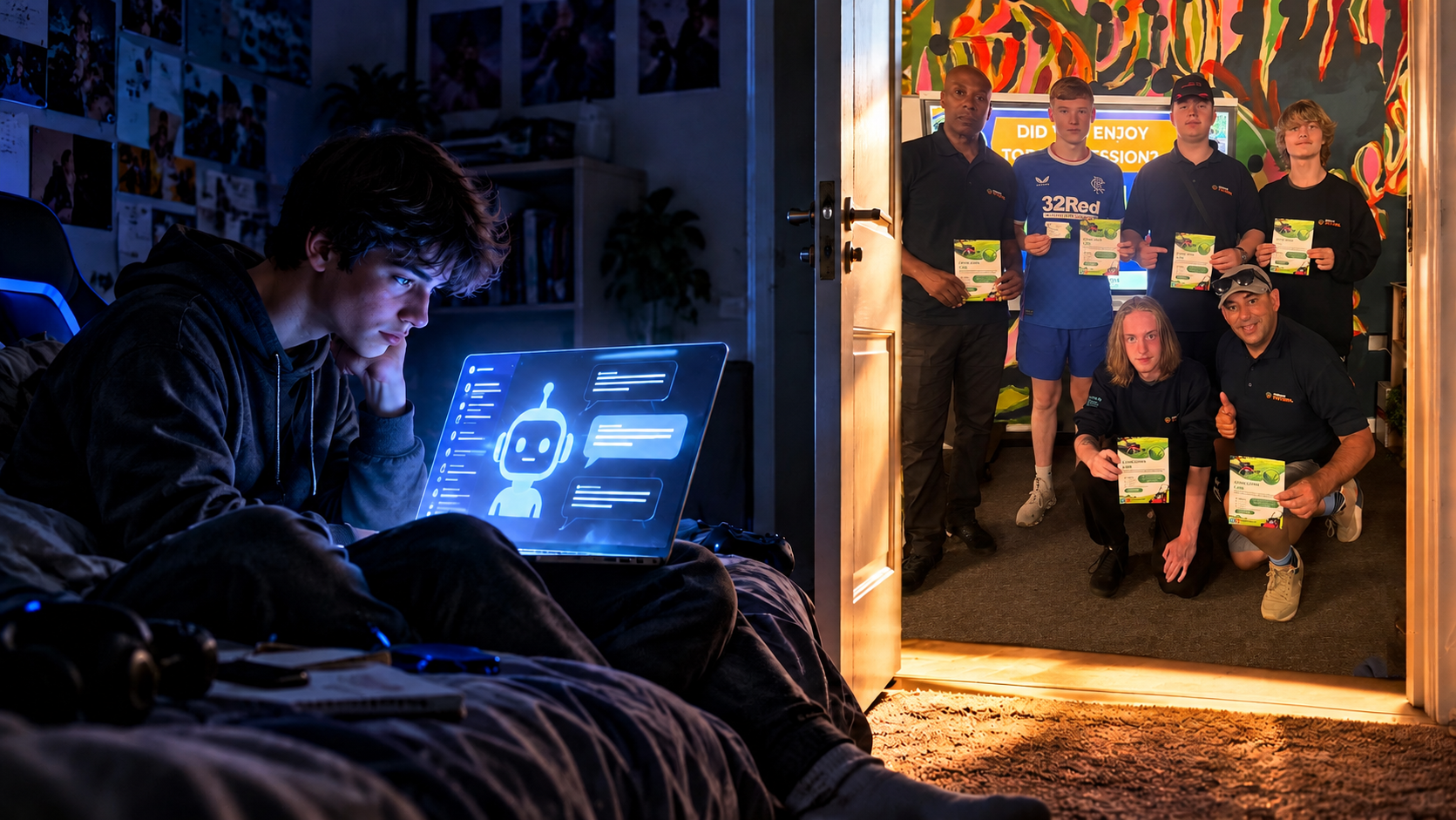
Welcome to the Bedroom Generation
At Genuine Futures, we have increasingly used the phrase “Bedroom Generation”.
It describes something we repeatedly see.
Young people spending more of their lives behind screens.
Disconnected from communities.
Disconnected from employment.
Disconnected from education.
Disconnected from positive adults.
Disconnected from opportunities that give them somewhere to go and something to work towards.
Technology didn’t create every one of these problems.
But technology can make it much easier to live within them.
A young person can now learn, play games, watch entertainment, communicate, shop and increasingly seek advice without leaving their bedroom.
That creates an enormous challenge for youth policy.
Because how do we reach a generation that no longer needs to step outside the front door to interact with the world?
Our answer cannot simply be another website.
Another leaflet.
Another referral pathway.
Another programme young people don’t know exists.
We need relationships.
We need belonging.
We need opportunity.
There’s Another Digital Divide Emerging
One of the most important findings in the research has received far less attention.
AI use was not equal.
The Public First research found that 92% of young people from the highest social grade had used AI, compared with 79% from the lowest.
And critically:
One in five NEET young people surveyed had never used an AI tool.
That matters.
Because while we rightly discuss the dangers of young people becoming over-reliant on artificial intelligence, another group risks being excluded from the opportunities it creates altogether.
The future labour market will increasingly expect people to understand how to work alongside technology.
AI literacy could therefore become another dividing line.
Not simply between those who have a laptop and those who don’t.
But between young people who understand how to use technology critically, creatively and productively — and those who don’t.
We cannot allow today’s opportunity gap to become tomorrow’s AI skills gap.
The Young People Furthest From Opportunity Cannot Be Left Behind Again
We already know what happens when systems fail to adapt quickly enough.
Some young people disengage.
Attendance drops.
Confidence disappears.
Education breaks down.
Then at 16, 18 or 21 we suddenly ask:
“Why is this young person NEET?”
Often the warning signs were visible years earlier.
This is why Genuine Futures continues to argue for:
Prevention before crisis.
The AI revolution makes that even more urgent.
Young people who have struggled within conventional education should not be excluded from the technologies reshaping employment simply because they learn differently.
Young people who are NEET should not be watching another economic revolution happen without them.
Care-experienced young people should not be left trying to navigate it alone.
Young people involved with youth justice should not have their future defined by their past.
And young people growing up in communities with fewer opportunities should not receive a second-rate digital future.
“We Can’t Prepare Young People for Yesterday’s World”
Genuine Futures Founder and Co-Director Sam Smith says:
“We cannot keep preparing young people for yesterday’s world and then blaming them when they disengage from it. AI isn’t coming — it’s already here. Our responsibility is to make sure every young person understands how to use it, question it and turn it into opportunity.”
But Sam believes something else matters even more.
“A young person might be able to ask AI a thousand questions, but AI cannot replace somebody believing in them. It cannot take them to their first employer, stand beside them when their confidence disappears or give them that feeling that somebody genuinely cares what happens next.”
That distinction is critical.
Technology can provide information.
People create belonging.
Human Relationships Become More Important, Not Less
As technology becomes more powerful, trusted human relationships become more valuable.
That means teachers. Parents. Youth workers. Mentors. Coaches. Employers. Community organisations. And people with lived experience who understand what disengagement actually feels like.
The Department for Education’s own earlier research into attitudes towards AI found concerns around over-reliance, loss of social and technical skills and reduced human contact.
Young people themselves valued teacher-pupil interaction and human oversight.
So the choice isn’t:
AI or people.
The challenge is:
How do we use AI while strengthening human connection?
This Is What Boss Your Future Is Trying to Do
Our Boss Your Future programme starts from a simple position:
Before asking a young person to change their life, build a relationship with them.
Listen.
Understand where they are.
Find out what they’re good at.
Then create something worth moving towards.
That might mean employment.
- College.
- Enterprise.
- Work experience.
- Creative media.
- Learning a trade.
- Meeting employers.
- Outdoor activities.
- Developing confidence.
Or simply getting out of the bedroom and becoming part of something again.
We’ve seen young people who had struggled before joining our programmes progress into employment, college, enterprise and leadership.
That progress did not start with a computer telling them what career they should choose.
It started with connection.
From Consumers of Technology to Creators of Opportunity
There is also an enormous opportunity here.
We shouldn’t teach disadvantaged young people merely how to consume AI.
We should help them use it to create.
Imagine young people using AI to:
- develop a business idea;
- design marketing campaigns;
- research careers;
- prepare for interviews;
- create digital content;
- build websites;
- understand finances;
- develop social enterprises;
- learn new workplace skills;
- and solve problems within their own communities.
That is where youth enterprise becomes increasingly important.
A young person doesn’t need to understand how to build an artificial intelligence model.
They need to understand:
What can this technology help me achieve?
That is a very different conversation.
Employers Need to Be Part of This
Schools and youth organisations cannot solve this alone.
Businesses have an important role.
Employers know how quickly workplaces are changing.
So bring young people inside them.
Show them.
Give them meaningful work experience.
Let them meet people doing real jobs.
Give them problems to solve.
Let them experience industries they might never otherwise encounter.
Help them understand where technology is changing roles — and where distinctly human skills remain essential.
- Communication.
- Reliability.
- Creativity.
- Problem solving.
- Teamwork.
- Empathy.
- Leadership.
- Enterprise.
These skills could become even more valuable in an AI-driven economy.
Our Challenge to Bolton – And Beyond
We should not wait until another generation becomes NEET before deciding something needs to change.
We need schools, colleges, employers, local authorities, youth organisations, community groups, parents and young people around the same table.
Not another conversation about young people.
A conversation with them.
Ask them:
- How are you using AI?
- What do you trust it with?
- What don’t adults understand about it?
- Does education feel relevant to the future you see coming?
- What skills do you actually want to learn?
- What would make you want to participate?
Then listen to the answers.
That is where innovation should begin.
AI Cannot Replace Hope
Artificial intelligence may become one of the most transformative technologies of our lifetime.
We should embrace its potential.
We should also understand its limitations.
AI can answer a question.
It cannot replace community.
AI can generate a CV.
It cannot provide work experience.
AI can suggest a career.
It cannot open the employer’s door.
AI can produce information.
It cannot replace belonging.
And AI can tell a young person what opportunities exist.
But somebody still needs to help them believe those opportunities belong to them.
That is our job.
- As parents.
- As educators.
- As employers.
- As communities.
- As organisations working alongside young people.
The answer to an increasingly artificial world must include something profoundly human:
relationships, belonging, purpose and opportunity.
Because whatever technology comes next, every young person still deserves someone in their corner.
Bridging the Gap to Opportunity
Genuine Futures CIC works alongside young people facing barriers to employment, education and opportunity through trusted relationships, lived experience, employability, enterprise and community partnerships.
Through initiatives including Boss Your Future, We Shine Any Car and our Young Futures Hub, we are creating practical routes into employment, enterprise, education and community.
If you are a young person, parent, school, college, employer, local authority, funder or community organisation, we want to hear from you.
Don’t wait until disengagement becomes crisis.
Refer early. Connect early. Create opportunity early.