It Takes a Town: Building a Better Future for Bolton’s Young People
Posted on:
Bolton’s Young People. Bolton’s Future. Our Shared Responsibility.
It takes a town.
Four simple words, but they capture something we have learned through working alongside children, young people, families, communities and partners across Bolton.
No single organisation can solve the challenges facing young people.
Not a school.
Not the council.
Not a charity or social enterprise.
Not an employer.
Not health services, housing, police or youth justice.
And certainly not a young person or family trying to navigate everything alone.
But when those pieces connect, something different becomes possible.
Across Bolton there are young people with talent, ideas, creativity and potential.
Some will progress through traditional education and employment routes.
Others will need something different: a trusted adult, practical learning, a second chance, an introduction to an employer, somewhere they belong or simply somebody prepared to ask:
“What do you want your future to look like?”
At Genuine Futures, we believe improving outcomes for Bolton’s young people has to become a shared mission.
Because it takes a town.
Look at the Reality Facing Bolton
Before we talk about opportunity, we have to understand the environment in which many children and young people are growing up.
Bolton has a population of more than 302,000 people, including around 97,000 children and young people aged 0–24.
Bolton Council’s own equality profile reported that 26% of Bolton residents live in neighbourhoods among the 10% most deprived nationally. It also recorded 33,266 children living in low-income households, alongside almost 26,000 unpaid carers, including hundreds of young carers. (Bolton Council)
Different poverty datasets use different definitions, age groups and methodologies, which matters when quoting the figures. DWP’s official figures for the financial year ending 2024 recorded 24,574 Bolton children under 16 in relative low-income families — 37.5% of children in that age group. (GOV.UK)
The latest DWP release, published in March 2026, now provides both Before Housing Costs and After Housing Costs local measures. Nationally, 3.27 million children aged 0–15 were living in relative low-income families after housing costs in the financial year ending 2025. (GOV.UK)
These aren’t simply statistics.
Behind every number is a child.
A family.
A classroom.
A neighbourhood.
And potentially a future being shaped long before that young person reaches the labour market.
“Who Are We Building Our Economy For?”
For Sam Smith, Founder and Co-Director of Genuine Futures, this raises a question that goes far beyond youth services:
“We talk constantly about building the economy. But who are we building our economy for if thousands of our children and young people are growing up without a genuine pathway into it?” — Sam Smith
That question matters.
Economic growth means very little to a young person who cannot see how they can participate in it.
We can attract investment.
Build homes.
Create developments.
Grow businesses.
Create new industries.
But alongside every economic strategy should be another question:
Where is the pathway for the young person growing up in Bolton today?
Where does a 14-year-old who is struggling at school fit?
Where does the 17-year-old who has left education without a clear destination go?
Where does the care-experienced young person find the networks many of their peers take for granted?
Where does the young person who learns practically rather than academically discover what they are capable of?
And where does the young person who has already made mistakes get their second chance?
If they cannot see themselves in Bolton’s future economy, we need to ask whether we have built the bridge properly.
Poverty Does Not Mean Lack of Potential
We need to be careful about how we talk about these challenges.
Growing up in poverty does not mean a child lacks ability.
Being NEET does not define a young person’s future.
Being care experienced is not a prediction of what somebody will become.
Struggling in a classroom does not mean somebody cannot learn.
And making a mistake at 15 should not determine the rest of someone’s life.
The challenge is often not an absence of potential.
It is an absence of access, networks, stability and opportunity.
That distinction matters.
Our job should not be to lower expectations for young people facing disadvantage.
It should be to remove the barriers preventing them from reaching those expectations.
“It Starts With One Conversation and One Seat at the Table.”
Cameron, one of the young people involved with Genuine Futures, put it better than we could:
“It starts with one conversation and one seat at the table.” — Cameron
Sometimes prevention really can start that simply.
A conversation.
Someone listening.
Someone recognising potential.
Someone opening a door.
Cameron has progressed from participating in Boss Your Future to becoming involved in practical enterprise, community activity and conversations about improving opportunities for other young people.
His experience is why we believe young people shouldn’t simply be recipients of programmes.
They should increasingly become contributors, leaders and designers of what comes next.
“We Can Achieve Anything Now.”
Luis, another of our young people, has described his journey in just a few words:
“We can achieve anything now.” — Luis
The important word is “now”.
The potential was already there.
What changed was access to relationships, experience, encouragement and opportunity.
Luis has progressed into a Youth Voice role and is now helping Genuine Futures reach other young people.
That is progression.
Not doing things to young people.
Not doing everything for young people.
But helping young people increasingly do things for themselves — and then helping others coming behind them.
EVERYONE KNEW: From Crisis Intervention to Prevention and Opportunity
This brings us to an uncomfortable question.
Why do we sometimes wait until a young person’s difficulties have escalated before significant support arrives?
Attendance starts falling.
Confidence disappears.
School becomes difficult.
College breaks down.
Employment feels increasingly distant.
Relationships with services deteriorate.
Other risks begin to emerge.
Eventually, several organisations may become involved.
By that stage, everybody can see the problem.
Our challenge is:
What did we know earlier?
That is why our presentation at the Bolton CVS Forum is called:
EVERYONE KNEW
From Crisis Intervention to Prevention and Opportunity
This isn’t about blame.
It is about learning.
If warning signs can be recognised earlier, how do we become better at connecting young people to opportunity before crisis takes hold?
Young People Need More Than a Voice
We hear the phrase “youth voice” regularly.
But genuine youth voice must mean more than another consultation.
Young people need to see that their contribution matters.
Sometimes they need the microphone.
When Genuine Futures speaks at the Bolton CVS Forum Meeting on Thursday 24 September, some of our young people will be standing alongside us.
They won’t simply feature in our presentation.
They will help deliver it.
Because the people experiencing systems often understand gaps in those systems in ways that reports alone cannot show us.
Relationships Come Before Programmes
For Mike Alleyne, Co-Director of Genuine Futures, consistency is central to the approach.
Young people need adults and organisations that listen, build trust, maintain appropriate boundaries and help them navigate towards opportunities that fit their strengths.
A programme can finish.
A funding period can end.
A course can have a final session.
A young person’s life doesn’t operate according to funding cycles.
That is why relationships, safeguarding and progression must sit alongside employability and skills.
Learning Through Real Enterprise
Education doesn’t have to look the same for everybody.
Traditional academic education is an important route for many young people.
But some young people thrive when learning becomes practical and connected to the real world.
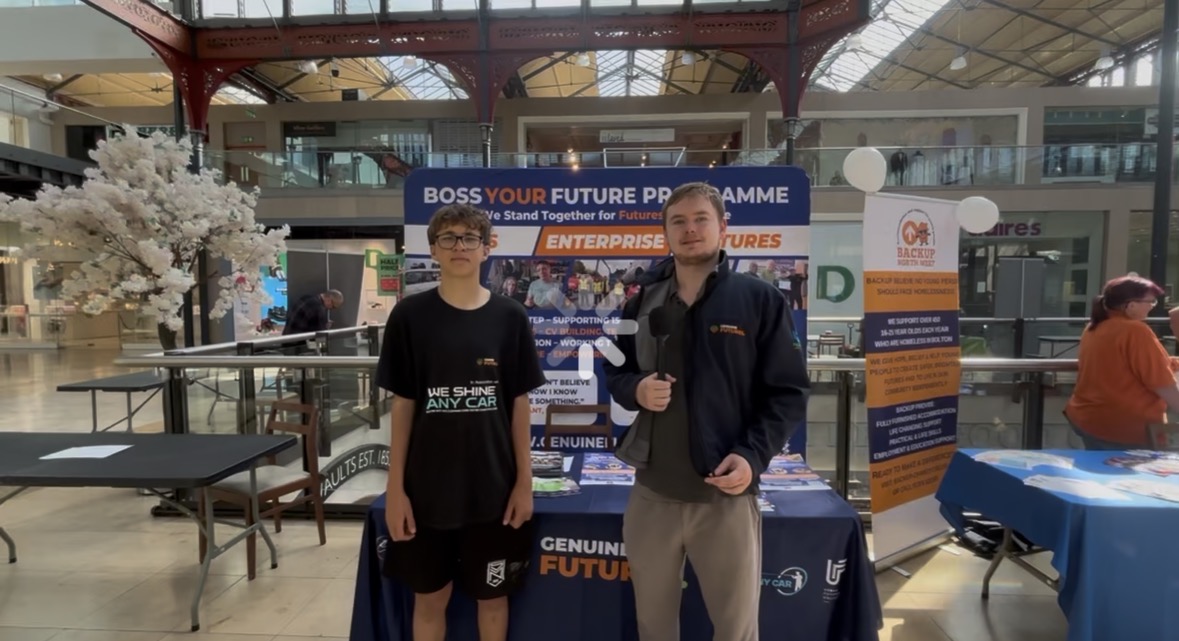
Through Boss Your Future and the developing We Shine Any Car Skills Academy, we are creating opportunities where young people can develop skills through practical activity and enterprise.
They can experience customer service, teamwork, timekeeping, quality standards, communication, costs, income, responsibility and problem-solving.
The enterprise becomes the classroom.
And the skills extend far beyond vehicle valeting.
They are skills for work, enterprise and life.
Safeguarding Has to Be Part of the Culture
Opportunity also has to be safe.
Our team recently completed Safeguarding Children and Young People training through Bolton CVS.
Following the training, Jen Clarkson, Senior Development Officer at Bolton CVS, said:
“The team were a pleasure to teach. They were all fully engaged throughout and gave some valuable input and insights into the session. They enhanced the experience for all participants.” — Jen Clarkson, Bolton CVS
Jen also welcomed team members’ interest in progressing to enhanced safeguarding training.
That matters.
If we ask children and young people to trust us, safeguarding cannot simply be a document.
It has to become part of organisational culture.
What If Bolton Connected the Pieces?
Bolton already has committed schools, colleges, businesses, community organisations, charities, social enterprises, public services and residents doing important work.
The answer isn’t necessarily to create another disconnected service.
Perhaps one of our greatest opportunities is to connect what we already have around the lives of young people.
Imagine a pathway that looked like:
School → Community → Vocational Learning → Employer → Enterprise → College → Apprenticeship → Employment
Imagine businesses opening their doors before a young person becomes long-term unemployed.
Imagine community organisations identifying disengagement early.
Imagine schools having more practical pathways available.
Imagine young people helping design the services intended for them.
Imagine businesses seeing youth opportunity not simply as corporate social responsibility, but as workforce development and investment in Bolton’s future economy.
And imagine measuring success not only by the crisis we responded to…
…but by the crisis that never happened because somebody acted earlier.
It Takes a Town
Genuine Futures cannot do this alone.
Nor should we.
Our role is to bridge the gap to opportunity.
But bridges need people on both sides.
Schools.
Colleges.
Employers.
Bolton Council.
Health services.
Housing providers.
Police.
Youth justice.
Voluntary organisations.
Social enterprises.
Funders.
Families.
Communities.
And, most importantly:
young people themselves.
Cameron’s words should stay with us:
“It starts with one conversation and one seat at the table.”
And Luis reminds us what can happen when opportunity begins to replace barriers:
“We can achieve anything now.”
So perhaps the question for all of us isn’t simply:
“How do we grow Bolton’s economy?”
It is:
“Who are we building our economy for?”
If the answer is our children and young people, then they need to be able to see a pathway into it.
Not when they reach crisis.
Now.
It Starts With Listening.
Prevention Before Crisis.
Bridging the Gap to Opportunity.
It Takes a Town.
One Town. One Opportunity at a Time.
If you’re a Bolton employer, school, college, community organisation, housing provider, public service or resident, ask yourself one question:
What opportunity could we create for one young person?
A placement.
A visit.
A mentor.
A vocational experience.
An introduction.
An apprenticeship.
A first job.
A second chance.
You don’t have to solve the whole problem.
Start with one conversation. One connection. One opportunity.
Then let’s connect those opportunities across Bolton.
Because Bolton’s young people aren’t simply beneficiaries of our future economy.
They are the people we’re building it for.