
From Exploitation to Opportunity: Can We Build a Better Future for the UK Car Wash Sector?
Posted on:
What If an Industry Associated With Exploitation Could Become a Route Into Opportunity?
For millions of motorists, visiting a hand car wash is an ordinary part of everyday life.
But research from Nottingham Trent University and The Clewer Initiative raises serious questions about what can sometimes be happening behind the shine.
Researchers estimate there are around 5,000 hand car washes operating across the UK and highlighted evidence suggesting more than 90% are likely to be employing workers illegally, including concerns around proper pay, employment records, PPE and first aid.
The research does not suggest every car wash is exploitative. There are legitimate operators doing things properly.
But it identifies a significant problem that Britain cannot ignore.
At Genuine Futures CIC, however, we believe there is another question worth asking.
Could we take an industry associated with exploitation in parts of the sector and demonstrate how it could instead create legitimate employment, skills and enterprise?
That is the thinking behind We Shine Any Car.
Two National Problems That Need Connecting
There is another important piece of evidence.
The Government-commissioned Young People and Work interim report, led by Alan Milburn, highlighted the scale of the challenge facing young people disconnected from employment and education.
At the end of 2025, 957,000 16 to 24-year-olds were not in education, employment or training (NEET).
Government has subsequently described the number as exceeding one million.
These might appear to be completely separate policy problems.
On one side, concerns about exploitation within hand car washes.
On the other, young people desperately needing legitimate routes into work.
We believe there is an opportunity to connect them.
“What Opportunity Are They Missing?”
Sam Smith, Founder and Co-Director of Genuine Futures CIC, said:
“Behind every NEET statistic is a young person with strengths, ideas and potential. We need to stop starting with what’s wrong with them and start asking: what opportunity are they missing?”
For some young people, entering conventional employment isn’t straightforward.
They may have experienced school exclusion.
Care.
Homelessness.
Contact with the criminal justice system.
Poor educational experiences.
Repeated rejection.
Or simply years without somebody helping them recognise what they are good at.
Sending another application form isn’t always enough.
Sometimes somebody needs somewhere they can simply start.
We Shine Any Car
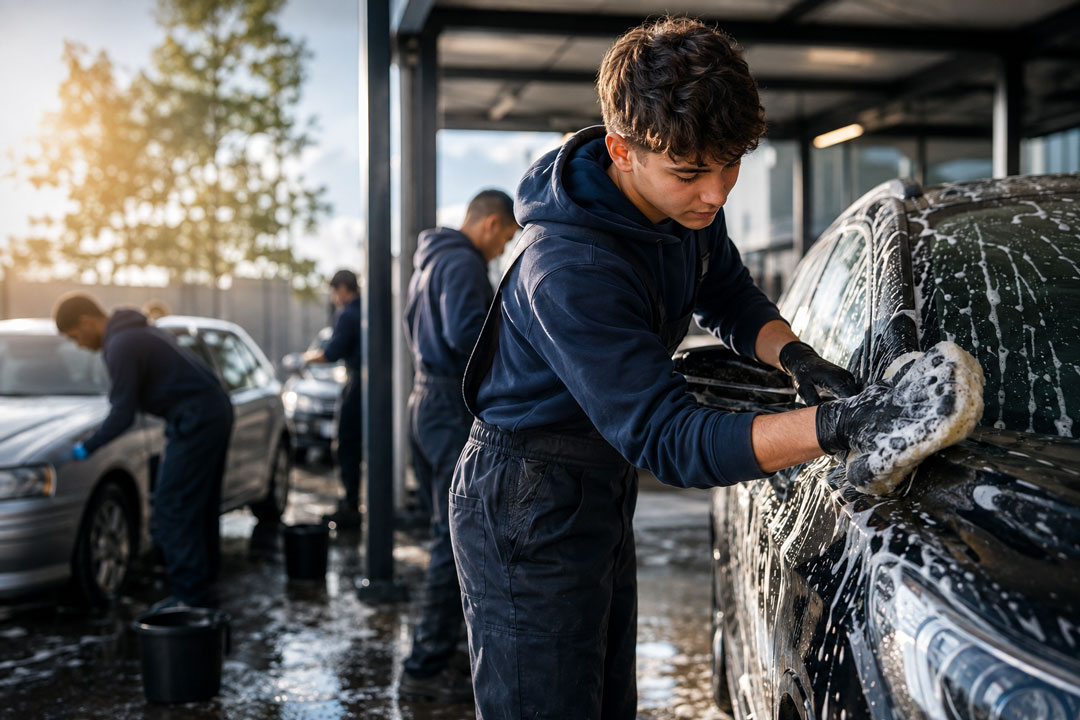
We Shine Any Car is our youth-led social enterprise using vehicle washing and valeting to create practical routes into employment and enterprise.
We’re washing cars.
But underneath that activity young people are learning:
- customer service;
- communication;
- teamwork;
- punctuality;
- responsibility;
- vehicle care;
- sales;
- money management;
- digital marketing;
- enterprise;
- leadership.
There is a real customer.
A real vehicle.
A real expectation.
And a visible result.
Sam explains:
“When people see a young person washing a car, they might just see a bucket, sponge and dirty vehicle. I see confidence, teamwork, customer service, responsibility and enterprise developing right in front of us.”
Young People Become Job Ready by Doing
The Milburn Review highlights some of the barriers facing practical employment pathways, including employer willingness, provider capacity and funding.
This reinforces something we see repeatedly.
Young people need real places to develop employability, not simply courses telling them how employment works.
Sam said:
“Young people don’t become job ready sitting at home waiting for somebody to give them a chance. They become ready by doing — turning up, meeting customers, learning responsibility, making mistakes and trying again.”
A car wash can provide exactly that environment.
And it doesn’t have to be the destination.
It can be the beginning.
From a Car Wash to a Career
A young person might begin washing vehicles and progress into professional detailing.
Another might discover mechanics.
Another sales.
Another marketing.
Another logistics.
Another could progress into an apprenticeship or college.
And somebody else might decide to build their own business.
The first opportunity doesn’t have to determine someone’s career. It simply needs to create momentum.
That is why enterprise can be such a powerful preventative tool.
Why Wait for Crisis?
Government is investing significantly in the Youth Guarantee and employment reforms.
That is welcome.
But prevention requires intervention before somebody has spent years outside opportunity.
Sam said:
“Eighteen months is an enormous amount of time in a young person’s life. Confidence disappears. Routine disappears. Connections disappear. We need to create opportunity earlier rather than waiting until disengagement becomes crisis.”
This is where community organisations and social enterprises can add significant value.
We can meet young people where they are.
Build trust.
Discover strengths.
Then connect that relationship to something real.
Don’t Just Give Young People Training. Give Them Customers.
There is another important part of the We Shine Any Car model.
Commercial sustainability.
Social enterprises cannot remain dependent indefinitely on grants.
Young people need customers.
Local authorities have vehicles.
Housing providers have fleets.
Police forces operate vehicles.
NHS organisations have vehicles.
Businesses have vans and company cars.
Those vehicles already need cleaning.
Why couldn’t some of that existing spending create additional social value?
Sam said:
“Don’t just give us funding to teach young people about work. Give young people some work. Bring us the vans. Bring us the cars. Become a customer and let them demonstrate what they’re capable of.”
That is a different model of social value.
The customer gets a professional service.
The young person gets experience.
The enterprise earns revenue.
And money circulates within the community.
Could This Become a National Model?
Our ambition goes beyond cleaning cars.
We want to explore whether We Shine Any Car can demonstrate a replicable model combining:
enterprise + youth employment + trusted relationships + prevention + commercial sustainability.
That could involve councils providing appropriate sites.
Automotive businesses providing equipment and expertise.
Colleges providing training.
Employers providing progression.
Public bodies providing fleet contracts.
Social investors providing growth capital.
And community organisations providing the trusted relationships that hold everything together.
Don’t Just Close the Bad. Build the Good.
Where exploitation exists, enforcement matters.
Workers must be protected.
Responsible businesses deserve a level playing field.
But regulation alone does not create an alternative.
Sam Smith said:
“Don’t just close the bad. Help communities build the good. If we know exploitation exists in parts of an industry, let’s demonstrate what that industry could look like when it is built around dignity, legitimate employment and opportunity.”
That is the bigger ambition behind We Shine Any Car.
Not simply cleaner vehicles.
Stronger futures.
Work With Genuine Futures
We want to speak with Government, councils, housing providers, police forces, NHS organisations, automotive businesses, training providers, employers, social investors, landowners and businesses operating vehicle fleets.
You could provide:
a customer;
a vehicle fleet;
equipment;
training;
a site;
work experience;
employment;
investment;
or sponsorship.
Sometimes changing a young person’s future doesn’t begin with another programme.
It begins when somebody gives them their first genuine opportunity.
We’re not just cleaning cars. We’re changing lives.
Genuine Futures CIC — Bridging the gap to opportunity.