
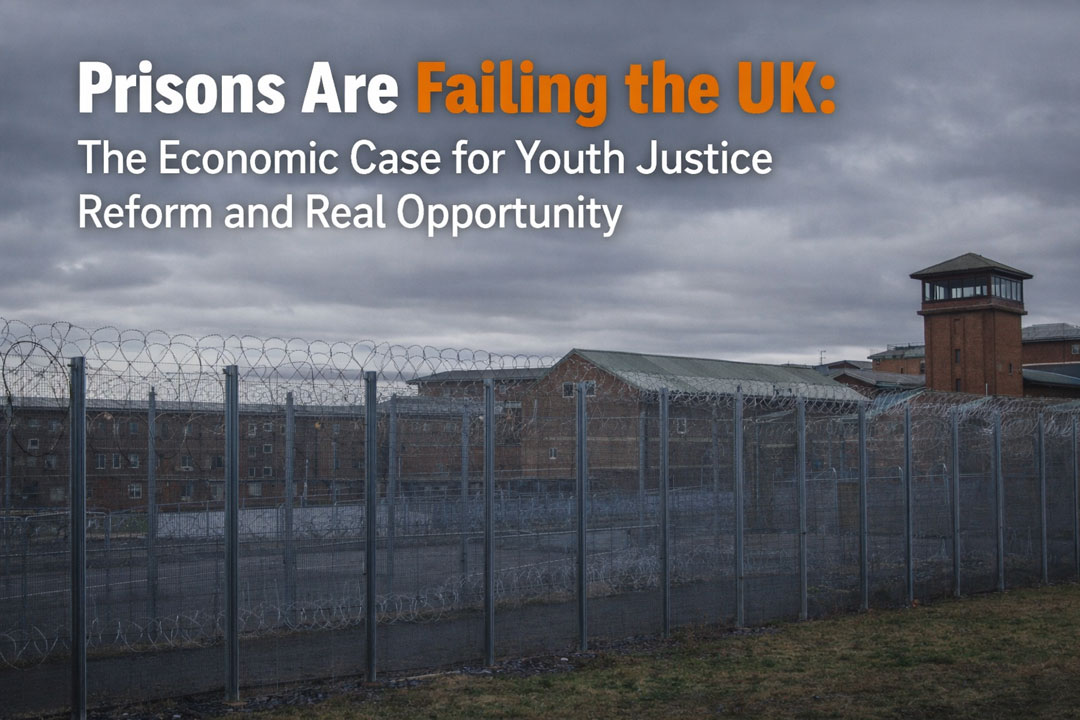
Prisons Are Failing the UK: The Economic Case for Youth Justice Reform and Real Opportunity
Posted on:
Economics is not just about money.
It is about choices. Outcomes. Efficiency. It is about using resources in the most effective way possible to deliver the greatest social return.
When we examine crime and punishment in the UK through an economic lens, the conclusion is unavoidable:
Our prison system is not working.
Not socially.
Not financially.
Not generationally.
And if we are serious about reducing crime, cutting public spending waste, and building safer communities, we must rethink where we invest.
The High Cost of Crime — and the Low Return of Prisons
Crime costs the UK economy billions each year when you combine:
- Policing
- Court proceedings
- Legal aid
- Incarceration
- Probation services
- Victim support
- Lost productivity
- Long-term social care costs
The public purse absorbs this impact year after year.
Yet despite this substantial investment, nearly half of adults released from prison reoffend within twelve months. For those serving short sentences, reoffending rates are even higher.
That is not rehabilitation.
That is a revolving door.
From an economic perspective, this represents a system delivering low return on very high investment.
If any business invested heavily in a programme that failed nearly half the time, it would redesign it immediately.
Yet in criminal justice, failure is normalised.
Prison: A Sentence That Doesn’t End
Release from prison is not a fresh start.
It is often the beginning of another struggle.
Former prisoners face barriers including:
- Difficulty securing housing
- Limited access to credit or insurance
- Employment discrimination
- Stigma in community settings
- Mental health challenges
- Disrupted family relationships
Only around a quarter of former prisoners enter employment shortly after release. Without stable work, stability is fragile.
And without stability, reoffending becomes more likely.
The economic impact extends beyond the individual.
Children who experience parental imprisonment are statistically more likely to:
- Experience mental health difficulties
- Struggle academically
- Enter care systems
- Become involved in the justice system themselves
This creates intergenerational cycles of disadvantage.
The prison system does not simply punish individuals. It compounds structural inequality across families and communities.
From a public policy standpoint, this is economically unsustainable.
The Evidence-Based Alternative: Community, Care and Opportunity
Research consistently demonstrates that the most effective crime reduction strategies are preventative rather than punitive.
Investments in:
- Early intervention
- Mental health support
- Education access
- Employment pathways
- Community-based mentoring
- Trauma-informed services
Deliver stronger outcomes at lower long-term cost.
These interventions reduce reoffending rates because they address root causes rather than symptoms.
Opportunity changes trajectories.
Punishment often reinforces them.
When individuals have access to meaningful work, belonging and support, they are less likely to return to crime. That is not ideology — it is economic logic.
Youth Justice Reform: Prevention Over Punishment
Youth justice reform is where this conversation must begin.
Young people who enter the justice system often carry histories of:
- School exclusion
- Poverty
- Care experience
- Trauma
- Adverse childhood experiences
- Unaddressed learning needs
These are not simply “bad choices.”
They are signals of unmet needs.
Locking up young people rarely resolves these underlying drivers. Instead, it interrupts education, fractures social ties and increases stigma.
If the aim is long-term public safety, prevention must replace reaction.
Inclusion must replace isolation.
Support must replace abandonment.
This is not softness. It is strategy.
Genuine Futures: A Practical Economic Solution
This is where community-led programmes such as Genuine Futures provide a working model.
Genuine Futures supports young people aged 15–24 who are not in education, employment or training (NEET). Rather than waiting for crisis intervention, the approach focuses on prevention, skills development and structured opportunity.
The model combines:
- Enterprise-led learning
- Employability pathways
- Mentoring
- Accredited training
- Outdoor engagement
- Community involvement
- Real-world work experience
Many participants arrive with backgrounds that include exclusion, housing instability, or contact with the justice system.
They are not defined by that history.
They are supported to build forward.
Young people have progressed into:
- Full-time employment
- Self-employment
- Apprenticeships
- Further education
- Peer mentoring roles
This is measurable social return on investment.
Every young person redirected from reoffending toward employment reduces long-term public spending and increases community stability.
Economically, prevention through enterprise is far more efficient than incarceration.
Sam’s Story: “They Gave Up on Me. I Didn’t.”
The mission behind Genuine Futures is rooted in lived experience.
At 14 years old, Sam was sent to Warrington House, a young offenders’ institution. That week inside marked the beginning of a decade caught in cycles of imprisonment and homelessness.
“When I left, there was no support. No plan. Just the same environment that led me there in the first place.”
Without structured opportunity, the cycle continued.
“They gave up on me. I didn’t. I always believed I had more to offer — I just needed a pathway.”
Eventually, Sam built his own route out, starting a business from scratch with a bucket and sponge. That entrepreneurial journey became the foundation for a broader mission: ensuring young people are supported before they become statistics.
“If someone had stepped in earlier, things could have looked different. Now we step in early for them.”
This is not theory.
It is transformation grounded in experience.
Redirecting Investment: From Punishment to Progress
If we evaluate criminal justice spending through economic impact, the conclusion is clear:
Investing primarily in incarceration delivers diminishing returns.
Investing in:
- Youth enterprise
- Skills development
- Community infrastructure
- Employment pathways
- Trauma-informed support
Delivers compounding benefits.
Every prevented reoffence reduces:
- Court costs
- Policing demands
- Prison expenditure
- Victim impact
- Long-term welfare reliance
At the same time, it increases:
- Tax contributions
- Community participation
- Social cohesion
- Intergenerational stability
This is not only morally sound. It is fiscally responsible.
The Future Is Built in Communities, Not Cells
Prisons may sometimes be necessary for public protection.
But they cannot be the default solution to social breakdown.
If we want safer communities, lower crime rates and stronger local economies, we must invest where outcomes are proven:
In people.
In prevention.
In possibility.
The future we want is not found behind bars.
It is found in youth hubs, workshops, classrooms, mentoring sessions, enterprise projects and community spaces where potential is cultivated rather than confined.
From punishment to progress.
From prison to potential.
Real reform is not radical.
It is rational.
A Final Word
Economics teaches us to ask one central question:
Are we using our resources in the most effective way?
When it comes to crime and punishment in the UK, the evidence suggests we are not.
But change is possible.
By shifting focus toward youth justice reform, community-led prevention and structured opportunity, we can reduce reoffending, strengthen families and build safer communities.
Everyone deserves more than a second chance.
They deserve a real pathway.
And when we invest in that pathway, society benefits as a whole.