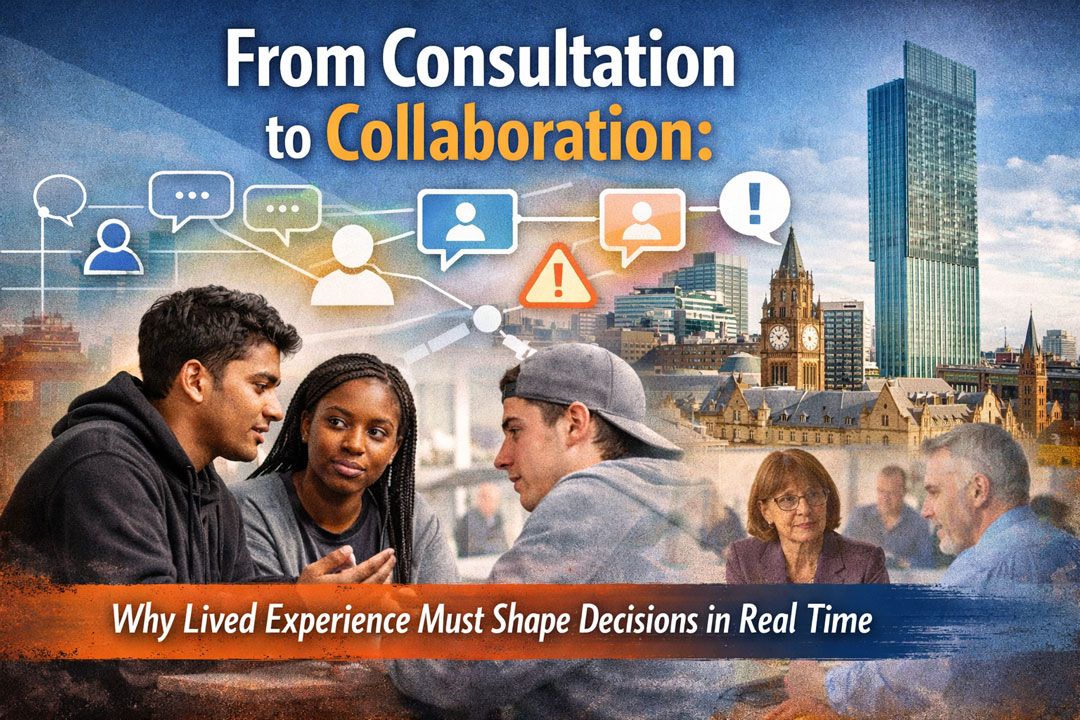
From Consultation to Collaboration: Why Lived Experience Must Shape Decisions in Real Time
Posted on:
Across Greater Manchester, there is no shortage of strategies, consultations, needs assessments, and reports. Every year, young people, families, frontline workers, and community organisations are asked to share their experiences. They do so openly, often painfully, trusting that their voices will help shape better decisions.
Too often, those voices are captured, transcribed, analysed—and then filed away.
As one young person put it:
“They asked us loads of questions, wrote everything down… and then nothing changed. It felt like it was just for a report.”
The problem is not that systems are not listening. It is that listening has become an event, not a practice. A process, not a relationship. A document, not a dialogue.
If we are serious about improving outcomes for young people—particularly those furthest from opportunity—we must move from consultation to collaboration, and from periodic listening to real-time engagement with consistent oversight.
Voices Are Heard, But Rarely Felt
For many young people navigating exclusion, care, youth justice, or long-term disengagement, being “consulted” often feels hollow.
They are asked to explain how school failed them, how services felt unsafe, how trust was broken early. They describe what might have helped sooner. Then months pass. Sometimes years. Nothing changes.
One young person involved with our work told us:
“I’ve told the same story to about six different people. Every time they say sorry that happened. Then you don’t hear back.”
At Genuine Futures, this is a common experience. It is not apathy. It is fatigue.
When voices are collected but never revisited, young people learn that honesty carries little value. Engagement becomes performative. Trust erodes. Silence sets in.
The Cost of Slow Listening in Fast-Moving Lives
Young people’s lives do not move at the pace of strategy cycles.
Risk escalates quickly. Exclusion happens suddenly. Mental health can deteriorate in weeks, not years. Criminal exploitation thrives in gaps between services, not within neatly planned frameworks.
Yet insight gathered today is often not reviewed until the next annual report or commissioning round.
As one young man explained:
“By the time they had a meeting about me, I’d already been kicked out of school and arrested. Everything came too late.”
This is where infrequent communication becomes more than an inconvenience. It becomes a safeguarding issue.
When insight moves slower than harm, systems become reactive by default.
When Systems React Instead of Prevent
One of the most consistent failures we see is not a lack of information, but a lack of coordination.
Schools raise concerns. Youth services notice patterns. Community organisations flag early warning signs. But without shared oversight and regular communication, these signals remain isolated.
A young person summed it up bluntly:
“Everyone knew something was wrong, but no one spoke to each other.”
Instead of preventing harm, systems respond after thresholds are crossed—when a young person is excluded, criminalised, or in crisis.
By the time safeguarding meetings happen, the narrative has already shifted from support to risk management.
What Collaboration Looks Like in Practice
True collaboration is not about adding more meetings or producing longer documents. It is about changing how insight flows and who is responsible for acting on it.
At Genuine Futures, our work across Bolton and Greater Manchester is built around continuous dialogue with young people—not one-off engagement exercises.
We listen early. We listen often. And we listen again as circumstances change.
This allows patterns to emerge in real time:
- Where systems unintentionally push young people away
- Where early support breaks down
- Where policy intent and lived reality do not align
One young person reflected:
“This is the first place that actually listened and then did something about it.”
That difference matters.
Oversight Is Not Control—It’s Accountability
Oversight is often misunderstood as bureaucracy. In reality, the absence of oversight is what allows insight to disappear.
Without clear responsibility for connecting voices across education, youth services, health, and the voluntary sector, learning falls through.