
The Lost Boys UK: School Exclusion, Care Breakdown and the Cost of Late Intervention
Posted on:
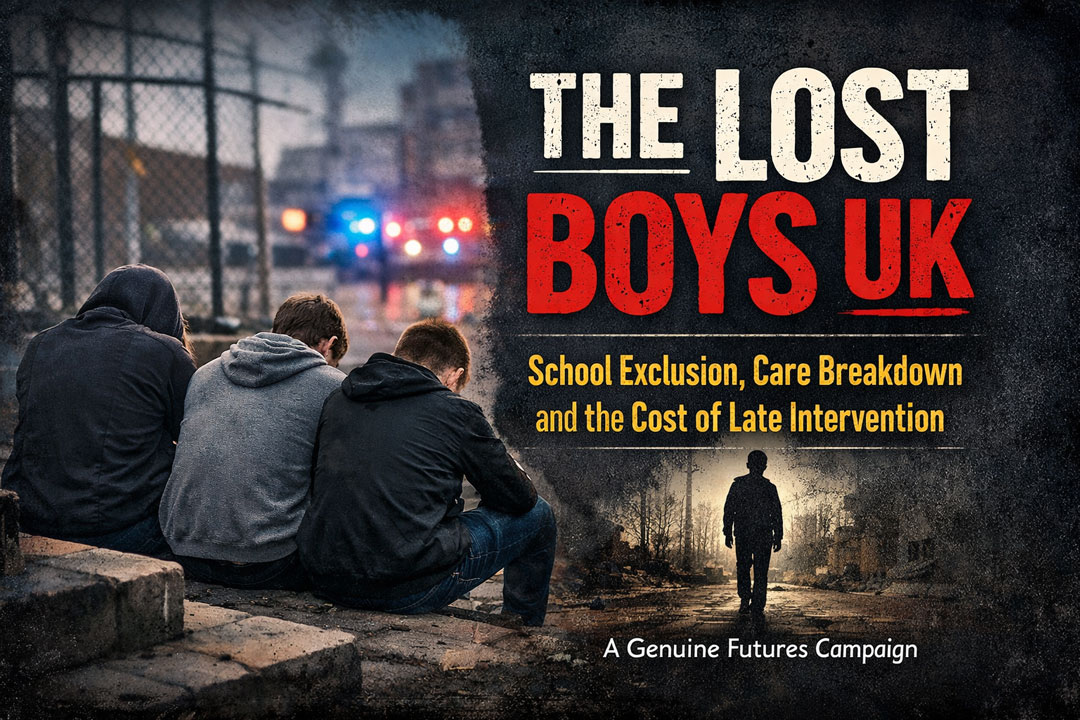
A Genuine Futures campaign
We are launching The Lost Boys campaign because we have lived it.
Not as a theory.
Not as a statistic.
But as children and young people who were slowly lost by systems that intervened too late, stayed too briefly, or disappeared altogether.
We weren’t born lost.
We didn’t wake up one day disengaged, angry, or written off.
We became lost quietly — through a series of small disappearances that no one seemed to notice at the time.
By the time people start asking where the boys have gone, they have often been missing for years.
Why this campaign exists
Across Bolton and Greater Manchester, we work every day with young people who are described as hard to reach, challenging, or at risk. What we see is something very different.
We see boys who were:
- Struggling long before exclusion
- Carrying unmet mental health needs
- Moving between homes, schools, and placements
- Losing trust in adults who didn’t stay
The Lost Boys campaign exists to challenge a damaging myth:
that boys disengage because they don’t care.
The truth is harder — and more uncomfortable.
Boys disengage when systems stop seeing them.
Where boys are first lost: school
For many boys, the first disappearance happens in the classroom.
Not because they can’t learn — but because learning becomes secondary to survival.
Unstable homes.
Hunger.
Poverty that follows them into school.
Being visibly different.
Being labelled before being understood.
That’s how the first labels arrive.
Not diagnostic ones.
Social ones.
Smelly.
Disruptive.
Trouble.
Behaviour is managed.
Context is ignored.
Support is mistaken for control.
Nationally, boys are more than twice as likely to be permanently excluded from school than girls. Exclusion is often framed as a sanction — but for many boys, it marks the moment the system stops trying to understand them and starts managing them out.
Care doesn’t always mean safety — instability harms
When families struggle, systems too often remove children rather than wrap around them.
Across England, more than 80,000 children are currently looked after by local authorities. Behind every statistic is a lived reality: bags packed with little explanation, placements that don’t last, and a constant sense of being temporary.
Care can protect — but instability compounds harm.
For many boys, care becomes another stage of disconnection rather than recovery.
From care to crisis: youth justice and deprivation of liberty
This is what the Lost Boys crisis looks like up close.
It doesn’t begin with crime.
It doesn’t begin with unemployment.
It begins with disconnection.
When boys are removed from school, then from home, then from community, crisis responses should not surprise us.
One of the clearest warning signs is the rising use of Deprivation of Liberty (DoL) orders.
In the first quarter of 2025 alone:
- 321 children were subject to DoL orders
- A 10% increase on the same period in 2024
- 2,252 applications since July 2023
Many involve children with complex mental health needs or perceived risks, placed in unregulated, unsuitable settings because there is nowhere else for them to go.
This is not a safeguarding success.
It is a system under strain.
When early support fails, crisis measures become normalised.
Exploitation fills the gap where belonging should have been
The streets don’t ask for CVs.
They don’t care about grades.
They offer belonging, status, and rules that make sense.
In today’s reality, that belonging is often weaponised.
Child criminal exploitation and county lines activity disproportionately target boys who are already disconnected — excluded boys, care-experienced boys, boys with unmet needs, boys who no longer trust adults because adults haven’t stayed.
They are not recruited because they are “bad kids”.
They are recruited because they are available.
Boys don’t disengage — they get disengaged
Language matters.
The question isn’t what’s wrong with them?
It’s where did we lose them?
The answer is rarely one moment.
It’s:
- Exclusion without alternatives
- Mental health needs without access
- Care without stability
- Classrooms without flexibility
- Systems that react late and leave early
Boys disengage when they don’t feel seen.
They withdraw when they don’t feel valued.
They act out when they don’t feel safe.
And they disappear when no one notices.
What Genuine Futures is doing differently
We launched The Lost Boys campaign because we believe a different approach is possible — and necessary.
At Genuine Futures, we focus on early, relational support, not late crisis management. Our work is rooted in lived experience and built around trust.
We support young people through:
- Personal development grounded in real relationships
- Outdoor activities that rebuild confidence, discipline, and teamwork
- Entrepreneurship education and hands-on, real-world pathways
- Youth-led social enterprises that create purpose, pride, and progression
Our 3-Step Pathway
Young people progress through a clear, practical route:
Step 1: Car Wash
Routine, teamwork, pride in work.
Step 2: Valeting
Responsibility, customer skills, attention to detail.
Step 3: Light Vehicle Maintenance
Mechanical skills, problem-solving, progression into work or training.
Our Youth-Led Enterprises
We Shine Any Car
A youth-led car wash and valeting enterprise, built with young people.
We Scrap Anything
A youth-led recycling and rebuild enterprise, creating skills, ownership, and hope.
We Scrap Anything is built on one principle:
Restoring Value.
Rebuilding Futures.
Recycling Hope.
Because when young people are trusted with real responsibility, they begin to see their own value again.
The opposite of “lost” isn’t “fixed”.
It’s connected.
A call to action
The Lost Boys campaign is not about blame.
It is about responsibility.
If you are:
- A business
- A school or academy trust
- A commissioner or funder
- A policymaker
- A community organisation
We are asking you to step in earlier, not later.
Early trust changes outcomes.
Late intervention manages harm.
Boys don’t need saving.
They need believing in — early enough.
Get involved
Concerned about a young person who feels excluded, stuck, or on the edge of disengaging?
Refer early.
Work with us.
Stand with us.
 hello@genuinefutures.co.uk
 01204 954200
 Bolton | Greater Manchester
The Lost Boys
A Genuine Futures campaign