
Known to the System. Overlooked by the System.
Posted on:
Why are we waiting for a crisis before we create opportunity?
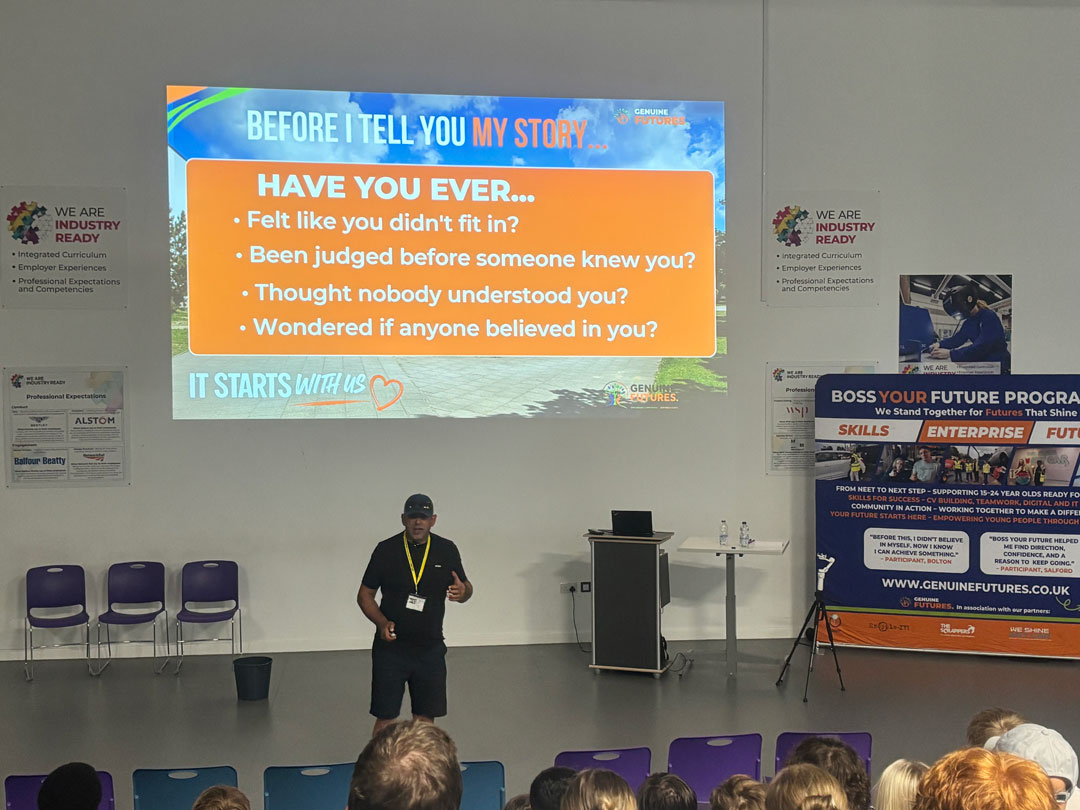
By Sam Smith, Founder and Co-Director of Genuine Futures CIC
There is a phrase we hear repeatedly when talking about young people who have been excluded from education, become NEET, experienced homelessness, entered the criminal justice system or become disconnected from their communities:
“They fell through the cracks.”
I no longer accept that phrase without challenging it.
Because many of these young people did not disappear.
They were not invisible.
They were known.
Known to schools.
Known to social care.
Known to health services.
Known to housing providers.
Known to youth services.
Known to the police.
Known to youth justice.
Known to employment services.
There may have been assessments, meetings, referrals, plans, interventions and professionals involved at different stages of their lives.
So perhaps the uncomfortable question isn’t:
How did they fall through the cracks?
It is:
How can a young person be known to multiple services and still reach crisis without a pathway to opportunity?
That is a question I believe we urgently need to confront.
Not because teachers, social workers, youth workers, police officers, NHS staff or other frontline professionals do not care.
I meet professionals every week who care deeply and are trying to make a difference within systems facing enormous pressure.
This is bigger than blaming individuals.
It is about asking whether the systems surrounding young people are genuinely organised around the life of the young person — or around institutional responsibilities, thresholds, budgets and boundaries.
Because a young person does not experience services as separate departments.
They experience one life.
Known to the System. Overlooked by the System.
Think about the journey of a young person experiencing multiple challenges.
Problems at home affect attendance at school.
Poor attendance becomes disengagement.
Disengagement becomes exclusion.
Exclusion affects qualifications.
Without qualifications, employment becomes harder to access.
Financial pressure increases.
The young person becomes NEET.
Perhaps housing becomes unstable.
Perhaps their mental health deteriorates.
Perhaps somebody involved in exploitation notices their vulnerability before an opportunity provider notices their potential.
Perhaps police or youth justice eventually become involved.
At every stage, another organisation may have known something was wrong.
Another referral.
Another assessment.
Another plan.
Another meeting.
Another professional trying to manage one part of the situation.
But the young person is carrying all of it.
Eventually, the situation reaches crisis.
And suddenly the response becomes urgent.
Which raises another question:
Why does crisis unlock more support than prevention?
We know many of the warning signs.
Persistent absence.
Repeated exclusions.
Placement instability.
Family difficulties.
Poor mental health.
Housing insecurity.
Low attainment.
Contact with police.
Becoming NEET.
Signs of exploitation.
Withdrawal from education or trusted relationships.
Yet meaningful intervention can still depend upon a young person reaching a particular threshold.
In plain English, sometimes things have to become worse before enough support becomes available.
That is not prevention.
That is responding to the consequences.
Children Looked After Deserve More Than Intervention
This matters particularly when we talk about children looked after and care-experienced young people.
When the state accepts responsibility for a child’s care, our ambition must extend beyond keeping that child safe today.
We have a responsibility to help them build tomorrow.
That means more than accommodation.
Young people need stable relationships.
Belonging.
Confidence.
Education.
Experiences.
Networks.
Someone who believes in them.
Someone who still answers when things go wrong.
Opportunities to discover what they are good at.
A pathway towards employment, education or enterprise.
And the freedom to make mistakes without those mistakes defining the rest of their lives.
A pathway into adulthood cannot simply be a document.
It cannot simply be a review meeting.
It cannot be another box ticked on a plan.
A real pathway consists of people, relationships, opportunities and practical support that remain when life becomes difficult.
If we would expect those things for our own children, why should our expectations be lower for a child looked after?
I Know What It Means to Become a Label
This matters personally to me because parts of this story are my story.
I entered care at 13.
I experienced exclusion, secure units and later prison.
As a young person, it became very easy for institutions to describe me according to what had happened or what I had done.
A problem.
An offender.
A difficult young person.
A risk.
A statistic.
Once a label becomes attached to somebody, there is a danger that it becomes more powerful than the person underneath it.
We start seeing behaviour rather than asking what happened.
We see risk rather than potential.
But underneath those labels, I was still a young person.
There were strengths.
Ideas.
Ambition.
Potential.
Those things had not disappeared because my circumstances had become difficult.
That experience influences everything we are trying to build at Genuine Futures today.
I don’t believe a young person should be defined by the worst thing that has happened to them.
Nor should they be defined forever by the worst decision they have made.
And I certainly don’t believe we should wait until someone’s circumstances become severe enough before we decide they are worthy of serious investment.
If support only arrives once somebody is excluded, homeless, exploited, arrested or in crisis, we have intervened too late.
Stop Calling Young People “Hard to Reach”
There is another phrase we need to challenge:
“Hard to reach.”
Sometimes the young person isn’t particularly hard to reach.
Perhaps the service is hard to access.
Perhaps the referral process is complicated.
Perhaps appointments happen somewhere they don’t feel comfortable.
Perhaps the programme bears little relationship to what motivates them.
Perhaps they have already told their story repeatedly.
Perhaps adults have promised things and failed to follow through.
Perhaps trust has been broken.
Or perhaps nobody has asked:
“What would make this worth engaging with for you?”
It is easier to describe somebody as hard to reach than to question whether what we are offering is reaching them.
At Genuine Futures, we have learned something simple:
Relationships often come before outcomes.
Trust cannot simply be commissioned into existence.
It has to be built.
Sometimes through a conversation.
Sometimes washing a car.
Sometimes boxing.
Sometimes learning a trade.
Sometimes running an enterprise.
Sometimes working at an event.
Sometimes sitting down over food.
Sometimes simply showing up again when a young person expected another adult to disappear.
Those moments may appear insignificant on a spreadsheet.
But they can be the beginning of something much bigger.
Opportunity Can Be an Intervention
We need to broaden our understanding of intervention.
Intervention doesn’t always have to mean another service delivered to a young person.
Opportunity itself can be an intervention.
A first work placement.
A first customer.
A first wage.
A qualification.
Learning to valet a car.
Trying a trade.
Meeting an employer.
Creating something and selling it.
Receiving a reference.
Being trusted with responsibility.
Joining a team.
Starting an enterprise.
Those experiences can create something that cannot simply be prescribed:
Belief.
The young person begins seeing themselves differently.
Not only as a care leaver.
Not only as an excluded pupil.
Not only as NEET.
Not only as an offender.
Not only as a risk.
But as an employee.
A creator.
An entrepreneur.
A teammate.
A colleague.
A leader.
A person with something valuable to contribute.
That change in identity matters.
What If We Reached Them Before the Prison Gate?
We talk extensively about rehabilitation.
We should.
People leaving prison need meaningful pathways into housing, employment, relationships and community.
But there is another question we cannot avoid:
What if we reached more young people before the prison gate?
Before arrest.
Before exploitation.
Before homelessness.
Before long-term unemployment.
Before years of disengagement.
Before a young person begins believing there is no legitimate place for them in society.
Prevention does not mean pretending every crisis can be avoided.
Nor does it mean replacing specialist mental health services, safeguarding, social care, housing or youth justice.
It means recognising warning signs and creating meaningful pathways earlier.
That is not being soft on consequences.
It is being serious about preventing them.
Prevention Is Also an Economic Argument
There is a social and moral case for prevention.
There is also an economic one.
Crisis requires resources.
Exclusion has consequences.
Homelessness has consequences.
Long-term unemployment has consequences.
Exploitation has consequences.
Youth justice involvement has consequences.
Prison has substantial human and financial costs.
But the cost isn’t measured only in public spending.
It is measured in lost education.
Lost confidence.
Lost relationships.
Lost employment.
Lost productivity.
Lost years.
And lost potential.
Instead of asking only:
“Has this young person reached the threshold?”
We should also be asking:
“What is likely to happen if nobody acts now?”
Investment in prevention should not be viewed simply as expenditure.
Done well, it is investment in future participation, employment, enterprise, stronger communities and reduced demand on crisis services.
Businesses Need a Seat at the Table
This cannot be solved by councils, schools and charities alone.
Businesses can become part of the prevention infrastructure within their communities.
Not simply through charity.
Through opportunity.
Employers can offer:
Workplace visits.
Mentoring.
Work experience.
Training.
Apprenticeships.
Jobs.
Supply-chain opportunities.
And contracts for youth-led social enterprises.
Instead of only asking businesses:
“How much can you donate?”
Let’s start asking:
What opportunity could you open?
What service could you purchase?
What skills could your employees share?
Who could you give their first chance to?
Businesses are not substitutes for social care, health, housing or education.
But they can provide something incredibly important:
A genuine place in the economy.
The Empty Chair
Imagine a meeting room.
Around the table sit representatives from education, social care, health, housing, police, youth justice, employment and community organisations.
Reports are discussed.
Risks are identified.
Actions are allocated.
But one chair remains empty.
The young person’s chair.
We can build increasingly sophisticated systems around young people while failing to build those systems with them.
Youth voice cannot be something added to the end of a project.
Young people need influence over the programmes and opportunities intended for them.
Ask them:
What would make you engage?
Where should support happen?
Who do you trust?
What would make you come back?
What do you want to achieve?
What barriers are adults missing?
What does opportunity look like to you?
And then demonstrate that their answers changed something.
Otherwise, youth voice becomes another consultation exercise rather than a transfer of influence.
We Need a Prevention Guarantee
I believe it is time to start a much bigger conversation about a Prevention Guarantee for young people.
The principle is simple:
When we know a young person is becoming vulnerable to exclusion, long-term unemployment, homelessness, exploitation or involvement with the criminal justice system, there should be a clear responsibility to create a pathway towards opportunity before crisis becomes the trigger for action.
That pathway will look different for different young people.
It might involve:
Education.
Employment.
Enterprise.
Mentoring.
Mental health support.
Stable housing.
Sport.
Creative activity.
Family support.
A trusted adult.
Often, it will require several of those things working together.
The important point is that someone takes responsibility for joining the pieces together.
Because when responsibility belongs to everybody, there is a danger that ultimately it belongs to nobody.
A Prevention Guarantee would not promise that every crisis can be prevented.
It would promise something more realistic:
No young person showing clear warning signs should be left with repeated referrals and no credible pathway forward.
What Would We Do If This Were Our Child?
There is one question I think every council, school, board, commissioning panel and organisation working with young people should ask:
If this were our child, would we accept this outcome?
Would we accept months without meaningful education?
Repeated referrals without meaningful change?
Leaving care without strong relationships?
Months or years without employment or training?
Being labelled hard to reach when nobody has built enough trust to reach them?
Would we wait until they entered the criminal justice system before surrounding them with intensive support?
If the answer is no, we should not accept those outcomes for somebody else’s child either.
They Were Never Invisible. They Were Overlooked.
These young people are not statistics.
They are not cases.
They are not risks to be passed between institutions.
And many were never invisible.
They were overlooked.
Their potential was overlooked.
Their voice was overlooked.
Their strengths were overlooked.
Sometimes we saw the behaviour but missed the reason behind it.
We saw the absence but missed the anxiety.
We saw the anger but missed the trauma.
We saw the offending but missed the exploitation.
We saw the refusal to engage but missed the years of disappointment that came before it.
We saw the label.
And stopped looking at the person.
That can change.
But it will require more than another programme, another strategy document or another meeting where everyone agrees things need to improve.
Schools.
Local authorities.
Health.
Housing.
Youth justice.
Employers.
Charities.
Social enterprises.
Communities.
And most importantly, young people themselves.
All working towards a shared ambition:
Prevent the crisis. Create the opportunity.
At Genuine Futures, we call it prevention before crisis.
Our promise remains:
Bridging the gap to opportunity.
We cannot prevent every crisis.
We cannot undo every failure of the past.
And we should never pretend that one programme can transform every life.
But we can refuse to accept a system where crisis becomes the point at which a young person finally receives the level of attention they needed years earlier.
The question is no longer whether we know who these young people are.
Often, we already do.
The question is:
What are we prepared to do differently once we know?
Join the Conversation
Genuine Futures CIC wants to hear from children and young people, care-experienced people, schools, local authorities, youth justice teams, housing providers, employers, funders, community organisations and policymakers who believe we need to move from crisis intervention towards prevention and opportunity.
We want to build the case for a Prevention Guarantee and, importantly, ensure young people’s voices help shape what it means in practice.
If you can create an opportunity, commission a pathway, provide employment, open a door, invest in prevention or help us influence change, we’d like to hear from you.
Let’s stop waiting for crisis.
Let’s start creating opportunity earlier.
Genuine Futures CIC
Bridging the gap to opportunity.